
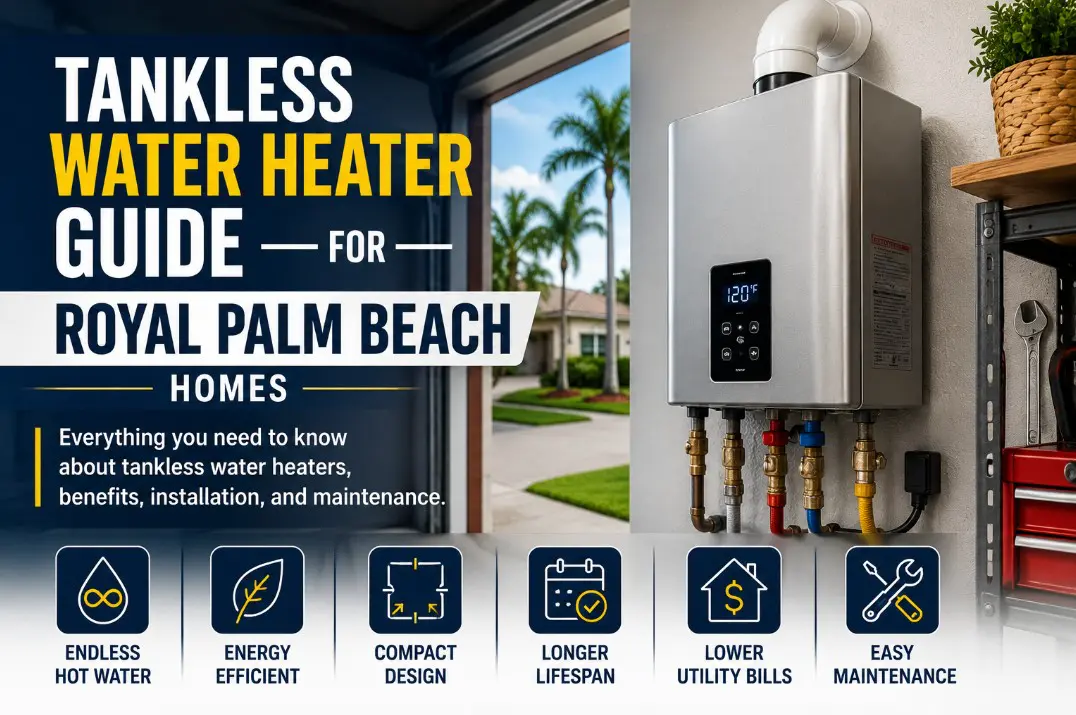
Tankless Water Heater Guide for Royal Palm Beach Homes
Hot water is essential for everyday activities such as showering, washing dishes, cleaning, and laundry. Traditionally, many Royal Palm Beach homes have relied on conventional tank-style water heaters that store heated water until it is needed. Tankless water heaters work differently by heating water as it flows through the system.
For homeowners considering a new water heater or evaluating their existing system, understanding how tankless technology works can make the decision easier. Tankless systems offer several potential advantages, but proper sizing, installation, maintenance, and household demand all play important roles in performance.
This guide explains what Royal Palm Beach homeowners should know before choosing or maintaining a tankless water heater.
How Does a Tankless Water Heater Work?
A traditional water heater stores a specific quantity of heated water inside a tank. Once that supply is depleted, the system must heat additional water.
A tankless water heater does not maintain a large reservoir of hot water. Instead, the unit activates when a hot-water fixture is opened. Water passes through the system and is heated before traveling to the faucet, shower, or appliance.
When hot-water demand stops, the unit shuts down.
Because water is heated when needed rather than continuously stored, tankless systems can reduce standby energy losses associated with keeping a tank of water hot throughout the day.
However, tankless does not mean unlimited capacity. Every system has a maximum flow rate and heating capability, making correct sizing particularly important.
Benefits of Tankless Water Heaters for Royal Palm Beach Homes
One of the main advantages of a tankless water heater is its ability to provide hot water without relying on a storage tank.
For households with appropriately sized systems, this can mean more consistent hot-water availability during consecutive showers or other daily activities.
Tankless units are also generally more compact than traditional storage water heaters. This can be useful in homes where utility-room, garage, or closet space is limited.
Another potential advantage is energy efficiency. Because the system does not continuously maintain a large tank of heated water, homeowners may reduce some standby energy consumption.
Tankless units can also have a long service life when correctly installed and maintained.
Homeowners interested in switching systems can explore professional Tankless Water Heater Services in Royal Palm Beach to determine what type and capacity may be appropriate for their household.
Choosing the Correct Tankless Water Heater Size
Choosing a tankless water heater based only on the physical size of the unit can lead to disappointing results.
The system needs to be sized according to the home’s hot-water demand.
A household may sometimes use several hot-water fixtures simultaneously. Someone could be taking a shower while a dishwasher or washing machine is operating. Each fixture adds to the total flow rate the heater must support.
The incoming water temperature and desired output temperature also affect how much heating capacity is required.
If the unit is undersized, homeowners may experience reduced hot-water flow or inconsistent temperatures during periods of high demand.
A properly sized system should consider household size, number of bathrooms, typical fixture usage, fuel or electrical availability, and expected simultaneous hot-water demand.
Tankless vs. Traditional Water Heaters
Both tankless and conventional water heaters can be suitable for residential properties, depending on the home’s requirements.
Traditional systems store heated water and are familiar to many homeowners. Their upfront installation can sometimes be simpler, particularly when replacing an existing tank with a similar model.
Tankless systems eliminate the storage tank and can provide hot water continuously within their rated capacity. They also occupy less physical space.
However, changing from a traditional heater to a tankless unit may require modifications to gas lines, electrical service, venting, water connections, or other infrastructure depending on the equipment selected.
Homeowners should therefore compare more than the purchase price. Installation requirements, household demand, operating costs, available utilities, and long-term maintenance should all be considered.
Signs Your Existing Water Heater Needs Attention
Homeowners do not necessarily need to replace a water heater simply because it develops a minor problem.
However, certain symptoms should not be ignored.
Inconsistent water temperature is one common warning sign. Hot water may suddenly become lukewarm, take unusually long to arrive, or fail completely.
Traditional tank-style units may also develop sediment buildup, leaking connections, heating-element problems, thermostat failures, or deterioration of the tank itself.
Water around the base of a traditional heater deserves immediate attention because a leaking tank or connection can damage nearby flooring and building materials.
If an existing system begins showing performance problems, professional Water Heater Repair in Royal Palm Beach can help determine whether repairing the unit is practical or whether replacement should be considered.
Tankless Water Heaters Still Require Maintenance
A common misconception is that tankless water heaters require no maintenance.
Minerals carried by the water can gradually accumulate inside heat exchangers and internal passages. Over time, this buildup may affect water flow and heating efficiency.
Periodic flushing or descaling can help remove mineral deposits, although maintenance requirements vary depending on the unit, water conditions, usage, and manufacturer recommendations.
Filters and other components may also require inspection or cleaning.
Ignoring maintenance can reduce performance and potentially shorten the service life of the equipment.
Homeowners should follow the maintenance schedule recommended for their specific unit rather than waiting until hot-water performance noticeably declines.
Installation Matters as Much as the Equipment
Even a high-quality tankless water heater may perform poorly if it is incorrectly installed.
The unit must have adequate energy capacity to heat water at the required flow rate. Gas-powered systems may require appropriate gas supply and venting, while electric models need sufficient electrical capacity.
Water connections must also be properly configured.
This is especially important when converting a home from a conventional tank-style heater to a tankless system because the existing infrastructure may not automatically support the new equipment.
A broader Plumbing Inspection in Royal Palm Beach can also help identify existing plumbing conditions that could affect a new installation or other parts of the home’s water system.
Is a Tankless Water Heater Right for Every Home?
Tankless systems offer several attractive benefits, but they are not automatically the best option for every property.
A smaller household with moderate hot-water demand may have very different requirements from a large family using several showers and appliances simultaneously.
Homeowners should consider installation cost, expected energy usage, available space, household demand, maintenance requirements, and how long they plan to remain in the property.
The condition of the home’s existing plumbing and utility infrastructure can also influence the decision.
Evaluating these factors before purchasing equipment can help avoid selecting a unit that does not match the home’s actual requirements.
When Should You Consider Replacing Your Water Heater?
Water heater replacement may become worth considering when an existing unit requires frequent repairs, develops significant leaks, no longer provides reliable hot water, or reaches an age where continued repairs are becoming less practical.
Replacement can also be considered during a larger home renovation or when homeowners want to improve energy efficiency or recover space currently occupied by a storage tank.
However, homeowners should avoid choosing equipment based solely on marketing claims.
The best water heater is one properly matched to the property’s plumbing system, available utilities, household size, and hot-water usage.
Choosing a Tankless Water Heater in Royal Palm Beach
Tankless water heaters can provide Royal Palm Beach homeowners with a compact and efficient approach to residential hot water when the equipment is properly selected and installed.
The most important considerations are correct sizing, professional installation, realistic expectations about simultaneous water usage, and regular maintenance.
Legacy Plumbing Experts provides water heater and plumbing services throughout Royal Palm Beach. Whether a homeowner is considering switching from a traditional tank, maintaining an existing tankless unit, or troubleshooting inconsistent hot water, evaluating the complete plumbing setup can help determine the appropriate solution.
Taking the time to choose the right system can provide reliable hot water while helping homeowners avoid unnecessary performance and installation problems in the future.
Tags: