
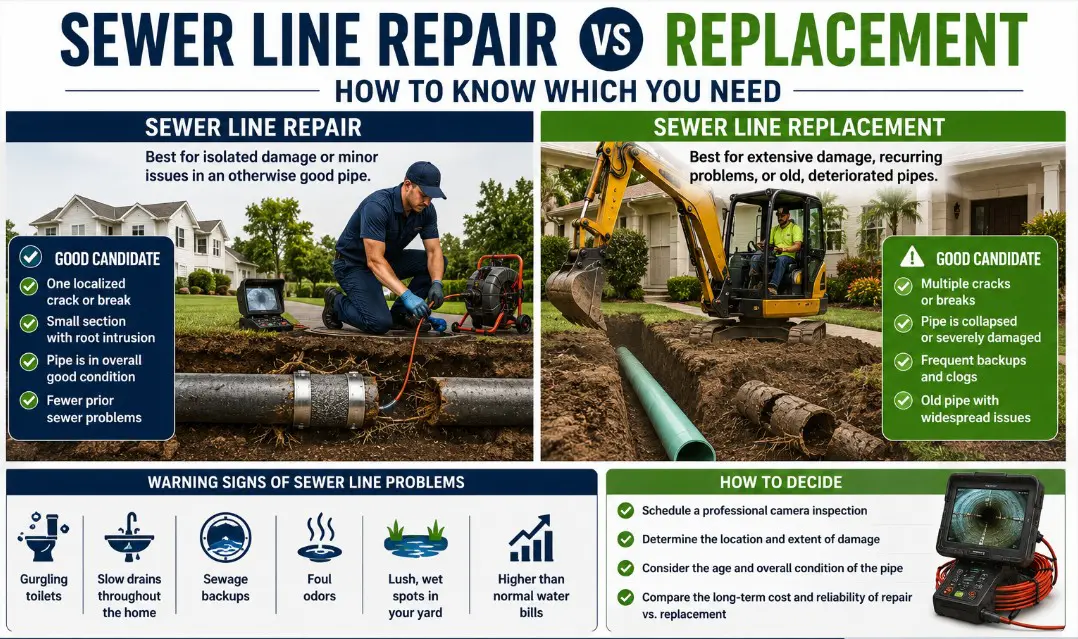
Sewer Line Repair vs Replacement: How to Know Which You Need
Sewer line problems can quickly become some of the most disruptive plumbing issues a homeowner faces. Slow drains, recurring backups, sewage odors, gurgling toilets, or unusually wet areas outside the home can all indicate that something is wrong with the main sewer line.
Once a problem is discovered, an important question follows: does the sewer line need to be repaired, or is complete replacement the better option?
The answer depends on several factors, including the location and extent of the damage, age and condition of the pipe, frequency of previous problems, and whether the line still has enough structural integrity for a lasting repair. Understanding the difference between sewer repair and replacement can help homeowners make a more informed decision.
What Is Sewer Line Repair?
Sewer line repair generally involves correcting a specific damaged or problematic section while leaving the rest of the sewer system in place.
For example, a pipe may have one cracked section, a damaged joint, localized root intrusion, or another isolated defect. If the surrounding sewer line remains structurally sound, repairing the affected area may restore proper wastewater flow without replacing the entire line.
The exact repair method depends on the pipe material, location, accessibility, and type of damage.
Professional Sewer Repair in Royal Palm Beach can help address localized sewer problems after the condition of the line has been properly evaluated.
The important factor is determining whether the damage is truly isolated. Repairing one section of a sewer line that is deteriorating throughout may only postpone another failure.
When Is Sewer Line Repair Usually Appropriate?
Repair can make sense when the majority of the existing sewer pipe remains in good condition.
A relatively new sewer line with one damaged connection, localized crack, or limited area of root intrusion may not require complete replacement.
Repair may also be appropriate when a specific obstruction has damaged a small portion of the pipe but the surrounding sections remain stable.
The location of the problem matters as well. A plumber needs to determine exactly where the damage exists before deciding whether a localized repair can provide a dependable solution.
Homeowners should be cautious about making this decision based solely on symptoms inside the home. Several different sewer problems can cause similar backups and drainage issues.
What Is Sewer Line Replacement?
Sewer line replacement involves removing, bypassing, or otherwise replacing a significant portion or all of a deteriorated sewer pipe.
Replacement is generally considered when repairing individual sections would no longer provide a practical long-term solution.
An older line may contain numerous cracks, deteriorated joints, severe corrosion, extensive root intrusion, collapsed sections, or widespread structural problems.
In these situations, repairing one damaged area may simply move the problem farther down the line.
Professional Sewer Pipe Replacement in Palm Beach Gardens may be considered when the existing sewer line has reached a condition where repeated repairs are no longer the most practical approach.
Signs Your Sewer Line May Need Repair
Not every sewer problem means the entire line needs replacement.
One common indication that repair may be sufficient is when a clearly identified problem is limited to one section of an otherwise healthy pipe.
Homeowners may experience recurring drainage issues, but an inspection may reveal that the majority of the line remains structurally sound.
Localized tree root intrusion can sometimes create a specific damaged area. Ground movement, construction activity, or deterioration around one connection may produce similar problems.
If the pipe has not experienced repeated failures elsewhere, repairing the affected section may provide an effective solution.
The decision should ultimately be based on the actual condition of the line rather than the severity of one backup.
Signs Sewer Line Replacement May Be the Better Choice
Replacement becomes more likely when problems are widespread or continually return.
A sewer line that has required several repairs in different locations may be approaching the end of its practical service life.
Extensive cracking, multiple displaced joints, severe deterioration, major root intrusion, or collapsed sections can make individual repairs less effective.
Age is another consideration, although an older pipe does not automatically need replacement. The material and actual physical condition matter more than age alone.
Homeowners should also consider the frequency of sewer problems. Repeated backups, constant root intrusion, and recurring repair costs can indicate that continuing to patch the existing line is becoming less practical.
Why Recurring Sewer Backups Shouldn’t Be Ignored
A single clogged fixture is often different from a main sewer problem.
When several drains become slow at the same time, toilets repeatedly gurgle, or wastewater backs up into showers and bathtubs, the problem may involve the main drainage system.
Repeatedly clearing the line can restore wastewater flow without correcting structural damage.
For example, a drain snake may temporarily remove material trapped around tree roots. If roots entered through a cracked joint, however, they may eventually grow back.
Likewise, cleaning debris from a damaged or partially collapsed pipe does not restore the structural integrity of that pipe.
Recurring backups therefore deserve further investigation rather than endless clog removal.
Camera Inspection Can Help Determine the Right Solution
Because sewer lines are mostly underground, homeowners cannot determine their condition simply by looking at drains inside the house.
A plumbing camera can be inserted into appropriate lines to examine their interior condition. This can help locate root intrusion, cracks, heavy buildup, displaced connections, obstructions, and other visible problems.
Professional Camera Inspection in Jupiter can provide useful information about underground plumbing conditions before decisions are made about cleaning, repair, or replacement.
An inspection is particularly valuable when sewer problems keep returning because it can help distinguish between an ordinary blockage and structural deterioration.
Tree Roots Can Influence the Repair vs Replacement Decision
Tree roots are a common concern for underground sewer pipes.
Roots naturally grow toward moisture. If a sewer line contains a small crack or loose joint, roots may enter the pipe and continue expanding.
Minor root intrusion in an otherwise sound pipe may require a different solution from extensive roots growing through several deteriorated sections.
Removing roots without addressing the opening that allowed them to enter may result in recurring problems.
When root intrusion is extensive and the pipe itself is significantly deteriorated, replacement may provide a more dependable long-term solution than repeatedly clearing and repairing individual sections.
Consider the Long-Term Cost, Not Just the Immediate Repair
A localized repair will often cost less initially than replacing a larger section of sewer pipe. However, the lowest immediate price is not always the least expensive option over time.
If the remaining sewer line is in poor condition, homeowners could pay for one repair and then experience another failure months later.
On the other hand, replacing a structurally sound sewer line because of one isolated defect may create unnecessary expense.
The goal should be to understand the overall condition of the system and compare the expected longevity of each option.
A professional evaluation can help homeowners balance immediate repair costs against the likelihood of future sewer problems.
Repair or Replacement: Which One Do You Need?
There is no universal answer for every sewer line.
Repair may be appropriate when damage is localized, the surrounding pipe remains structurally sound, and there is no history of widespread recurring failures.
Replacement may be the better option when deterioration affects multiple sections, the pipe is collapsing, roots have extensively invaded the system, or homeowners have already paid for repeated repairs.
The most important step is accurately identifying what is happening underground before making the decision.
Legacy Plumbing Experts provides sewer and plumbing services throughout Palm Beach County communities. Evaluating the condition, location, and extent of sewer-line damage can help determine whether targeted repair or replacement offers the more appropriate long-term solution.
Choosing based on the actual condition of the pipe—not simply the latest backup—can help homeowners avoid unnecessary work while protecting their plumbing system from recurring sewer problems.
Tags: