
Can Hydro Jetting Damage Old Pipes? What Homeowners Should Know
If you have an older home and a plumber recommends hydro jetting, it’s reasonable to wonder whether all that water pressure could damage your pipes.
The answer isn’t a simple yes or no.
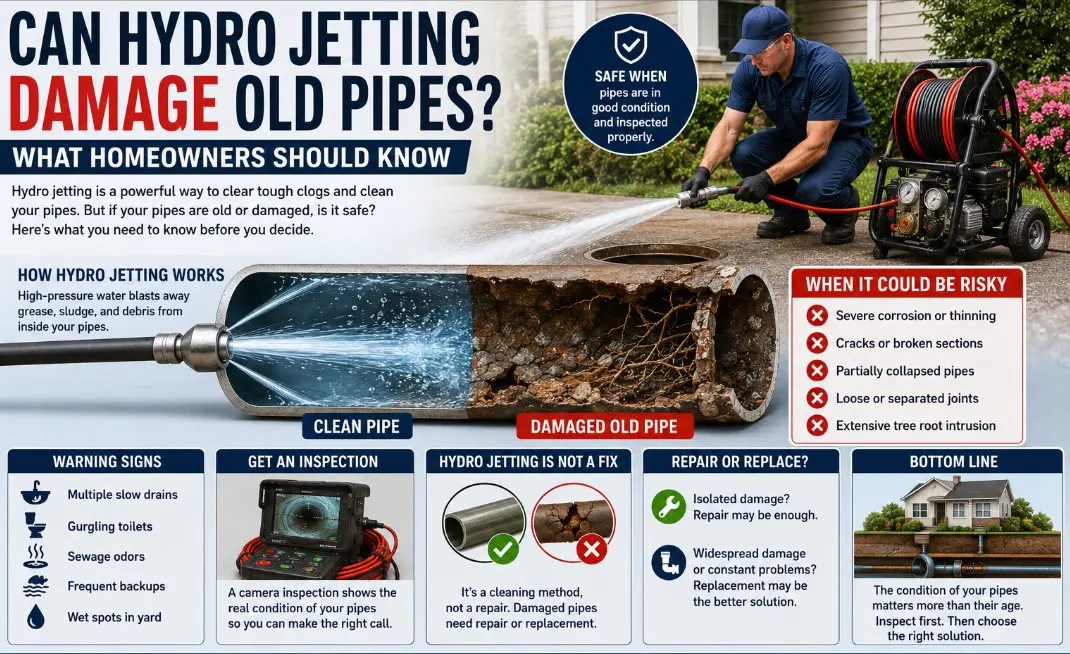
Hydro jetting is designed to clean the inside of drain and sewer lines using high-pressure water. On pipes that are still in good condition, it can be an excellent way to remove years of grease, sludge, soap buildup, and other debris. But if a pipe is already badly corroded, cracked, separated at the joints, or beginning to collapse, blasting it with high-pressure water may not be the right move.
So the real question isn’t necessarily how old your pipes are. It’s what kind of shape they’re in today.
Age Alone Doesn’t Tell the Whole Story
People often assume an old plumbing system must be fragile. That isn’t always true.
A 30-year-old drain line that has been maintained and remains structurally sound may handle professional cleaning without a problem. Meanwhile, a much newer pipe can be damaged by ground movement, tree roots, poor installation, or other issues.
Pipe material matters too. Homes built during different periods may have PVC, cast iron, copper, or other materials throughout the plumbing system. Those materials don’t all age in the same way.
That’s why a plumber shouldn’t look at the age of your house and automatically decide whether hydro jetting is safe.
The condition of the actual line matters much more.
When the pipes are suitable for high-pressure cleaning, Hydro Jetting in Palm Beach Gardens can remove stubborn material that ordinary drain clearing may leave behind.
Why Hydro Jetting Works So Well on Tough Buildup
Think about what happens inside a kitchen drain over the years.
Small amounts of cooking grease enter the pipe. Soap and food particles stick to it. More grease follows. Eventually, the inside of the pipe can develop a thick coating that leaves less room for water to pass.
A drain snake can be useful for breaking through a clog and getting things moving again. But it doesn’t always remove the material stuck along the walls.
Hydro jetting takes a different approach.
A specialized hose and nozzle send pressurized water through the line. The water works against buildup while helping flush loosened debris farther through the plumbing system.
For the right pipe, that’s a big advantage. Instead of only opening a path through the clog, you’re dealing with much more of the material that helped create it.
Where Old Pipes Can Become a Concern
Here’s where homeowners need to be careful.
Suppose an old sewer line has been corroding for years. One section has become thin, another has a crack, and two joints are beginning to separate.
That isn’t simply a dirty pipe anymore. It’s a damaged pipe.
Hydro jetting isn’t going to repair those weak spots. More importantly, a plumber needs to know those conditions exist before deciding whether high-pressure cleaning is appropriate.
The same applies to a line that has partially collapsed or has severe root damage.
This is why the phrase “hydro jetting damaged my old pipe” doesn’t always tell the complete story. Sometimes the pipe was already close to failure, and the underlying deterioration was the real problem.
Don’t Guess When the Pipe Is Underground
Most sewer lines aren’t visible, which makes this difficult for homeowners. You can see that the kitchen sink is draining slowly. You can hear a toilet gurgling. You know you’ve had three clogs in the past year. What you can’t see is what the inside of that underground line looks like.
Maybe it’s simply dirty. Maybe tree roots have entered through a joint. Maybe part of the pipe has shifted. Or perhaps an old section has started deteriorating.
This is where Plumbing Inspection Services in Wellington can be valuable. Looking more closely at the plumbing before choosing a cleaning method takes much of the guesswork out of the decision.
Recurring Clogs Are Worth Paying Attention To
One clogged drain isn’t unusual.
The same drain clogging every few months is a different story.
Imagine clearing a sewer line in March, again in June, and then dealing with another backup before the end of the year. At that point, simply clearing it again without asking why it keeps happening isn’t much of a long-term plan.
Recurring clogs can happen because buildup was never fully removed. But they can also be caused by a physical problem with the pipe.
Tree roots are a good example.
Roots don’t normally enter a completely sealed sewer pipe. They take advantage of cracks, gaps, and failing joints. Once inside, they grow and catch waste moving through the line.
You can remove the roots, but if the damaged opening remains, there’s a good chance you’ll see them again.
Sometimes Cleaning Isn’t the Answer
This is probably the most important thing to know about hydro jetting: it’s a cleaning method, not a pipe repair method.
There are situations where cleaning the line is exactly what it needs.
There are other situations where repeatedly cleaning it is just postponing the repair.
If a pipe has one damaged section but the rest remains in good condition, a localized repair might solve the underlying issue. If deterioration runs through a large portion of an older line, a plumber may recommend something more extensive.
For example, Sewer Repair in West Palm Beach addresses a very different problem from removing grease and sludge inside an otherwise healthy sewer pipe.
Knowing which problem you actually have is the key.
What Should You Tell Your Plumber Before Hydro Jetting?
If you live in an older home, give the plumber some history.
Mention previous sewer backups. Tell them if roots have been found before. Point out drains that repeatedly slow down or toilets that regularly gurgle.
If you’ve had previous underground pipe repairs, that’s useful information too.
These details may change how the plumber approaches the job.
You don’t need to diagnose the plumbing yourself. But knowing its history makes it easier to spot situations where an inspection should come before high-pressure cleaning.
A Few Signs Your Pipes May Need a Closer Look
One slow bathroom sink probably isn’t enough to assume your sewer line is failing.
Several problems happening together are more meaningful.
If multiple drains suddenly become slow, wastewater backs up into a shower, sewage odors keep appearing, or the main line needs frequent clearing, it’s worth finding out what’s happening below the surface.
The same goes for older homes where nobody knows the condition of the underground plumbing.
In those cases, going straight to the strongest cleaning method without checking the pipe first may not make sense.
So, Can Hydro Jetting Damage Old Pipes?
It can be a concern when pipes are already severely weakened or damaged. But old doesn’t automatically mean unsafe for hydro jetting.
A structurally sound older pipe and a badly deteriorated older pipe are two very different things.
That’s why the safest approach isn’t to avoid hydro jetting simply because your home is older. It’s to make sure the condition of the plumbing matches the cleaning method being considered.
Legacy Plumbing Experts works with drain and sewer systems throughout Palm Beach County. If an older plumbing system has recurring clogs or hasn’t been inspected in years, checking what’s happening inside the line first can make the next step much clearer.
Sometimes the answer is hydro jetting. Sometimes it’s a simpler drain cleaning. And sometimes the pipe itself needs attention.
Finding that out before the work begins is what matters.
Tags: